

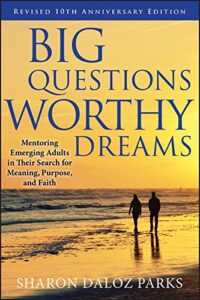
 Sharon Daloz Parks, Big Questions, Worthy Dreams: Mentoring Emerging Adults in Their Search for Meaning, Purpose, and Faith (Minneapolis, MN: Fortress Press, 2019).
A book review by Jack Finnegan
Principal, director of Leadership for the New Commons, and a senior fellow at the Whidbey Institute at Clinton, WA, a place dedicated to transformational learning, Sharon Daloz Parks held faculty and research positions at Harvard University in the schools of Divinity and Business, and the Kennedy School of Government for 16 years.
She also teaches at Seattle University in the Executive Leadership Program at the Albers School of Business, speaks and consults nationally on higher education, religion, and business and is the recipient of five honorary degrees. Her long list of publications includes Leadership Can Be Taught: A Bold Approach for a Complex World, and Big Questions, Worthy Dreams: Mentoring Emerging Adults in Their Search for Meaning, Purpose, and Faith. She is also a co-author of Common Fire: Leading Lives of Commitment in a Complex World.
James Fowler and others, including Piaget, Kohlberg, Gilligan, and Kegan, influenced Park’s approach to faith development. She has a higher education and campus ministry background. Her faith development theory focuses on young adults’ meaning making between the ages of 17 and 30. Parks defined faith as seeking and discovering meaning in the most comprehensive dimensions of our experience. Like Fowler, she also distinguishes between religion and faith. Parks added the “Young Adult Faith” stage to her theory, as she felt Fowler overlooked this period when developing his own theory.
 Her theory encompasses four stages through which adolescents, young adults, and adults move. Parks’ believes higher education institutions function as mentoring communities that foster big questions and thus faith development, such as: Why is suffering so pervasive in the world? Is there a master plan? What do I want to become? Parks believes a “worthy dream” is an imagined possibility that orients meaning, purpose, and aspiration. Developing these dreams is critical for young adults, while the implications for older people remain self-evident. Do we allow our lives and actions to be motivated by worthy dreams? However, a lack of universal and multicultural applicability has led to criticism of her and Fowler’s approaches to faith development.
Big Questions, Worthy Dreams: Mentoring Emerging Adults in Their Search for Meaning, Purpose, and Faith (Minneapolis, MN: Fortress Press, 2019) has been published three times since 2000, with extensive revision in the latest edition. The book is recommended reading in spiritual care and mentoring for several reasons. Our economic and political life has become more brittle, volatile, and global. Wars and violent conflicts confront us. The planet is under threat. The result is a paradoxical enlarging and constraining of young adult hopes and aspirations. Today’s emerging adults are both more connected and more distracted, while religion and faith have become both problematised and polarised.
Parks defines faith as meaning making in its most comprehensive dimensions, whether expressed in secular or religious terms. Over time, our meaning making orients our sense of purpose, moral stance, and competence. The latest edition of the book underlines the potential vulnerability of emerging adults. It shows how spiritual carers and mentoring environments can provide access to big enough questions and inspire dreams worthy of engaging with our challenging and complex world. Parks addresses essential issues of the day, including violence in our culture, social media and networking, economic challenges, changing racial identity, cultural shifts, and other forces shaping the narrative of emerging adulthood today.
— Jack Finnegan